
What Does It Mean for an Organization to "Do Strategy"?
⬇ Download PDFEarly in my career, I was passed over for roles in strategy practices at two global consulting firms. To explain their decision, hiring managers said my background was not concentrated enough around what they'd been selling. Rather, they moved forward with transaction and capital professionals who had deep finance experience in buy-side/sell-side deals or complex CapEx events — think P3 partnerships or large building campaigns.
One of these firms aspired to become the leading global strategy advisor, in part by doubling the talent bench of professionals who deliver transaction advisory services.
With such focus being placed on these matters, are we right to conclude that practicing strategy is synonymous with analysis and decisions on deals and balance sheet concerns? Moreover, do professionals who come from firms with this orientation largely represent what's needed to be an effective practitioner in the field of strategy?
One way to understand the profession of strategy is to map the sphere of its concerns. In their book Strategy Process: Shaping the Contours of the Field, Chakravarthy, Stewens, Lorange, and Lechner explain that doing strategy is about three activities: crafting, implementing and changing strategy. [1] They offer a framework that integrates these disparate aspects. A summary and discussion of the framework follows.
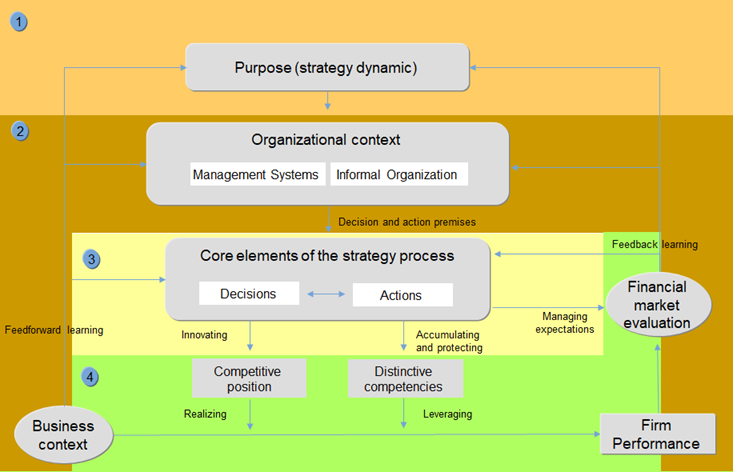
Four interconnected streams that define the full sphere of organizational strategy — adapted from Chakravarthy, Stewens, Lorange & Lechner (2003).
The Four Streams of Doing Strategy
This stream is about how a firm monitors and defines its strategy dynamics relative to others in the competitive environment. Four types of strategy dynamics for any strategy include: a) improving a current position perhaps by imitating other firms with a similar strategy; b) optimizing or maintaining an already established and enviable competitive position; c) innovating to go beyond a current position; d) migrating from one strategy (e.g., product leadership) to another (e.g., low-cost).
Time changes the strategy dynamics of an organization and affects the interrelationship of all the other elements in the framework. The task of strategy participants in this stream has to do with perceiving and initiating change — or maintaining continuity — in organizational identity and purpose over time. Vetting deals or setting the CapEx agenda may ultimately be a means for achieving changes in the strategy dynamic. However, doing the work to assess the external environment, reflect on fresh intent and evolve the strategy dynamic is its own task. It often requires little transactional talent.
This stream is about how characteristics in a firm's internal context influence strategic decisions and actions. Here strategists are interested in trying to understand the contextual factors that promote superior implementation and performance relative to firms with otherwise similar characteristics.
There are two broad types of contextual factors that influence actions and decisions: 1) management systems (e.g., prevailing structures, planning, control, incentive systems) and 2) informal organization (e.g., values, norms, culture, leadership approach, environment for non-sanctioned experimentation). Kaplan and Norton cite research suggesting that firms with formal strategy management systems outperform peers without a formal system. [2][3] We also understand that a firm's leadership approach and culture can be a powerful enabler or constraint in generating new or innovative pathways and supplying the environment necessary to implement strategy. [4]
Strategy practitioners in this stream design, deploy and adapt management systems and leadership behaviors that enable firms to institutionalize strategy, align resources and improve decision making. They also initiate leadership and organizational development initiatives to positively influence culture and context.
Stream three centers on the two most central components in the strategy process. The two-way arrow between decisions and actions indicates that strategy formulation and implementation are interdependent. Strategy formation decisions (e.g., innovations and new competitive positions) are analytically and creatively planned — but also emergent and apprehended.
Here, strategy practitioners are concerned with how to make and implement strategy choices given their current organizational context. [5][6] They need integrative thinking skills to deal with the continual management of options and revisions between strategy decisions and actions. Moreover, it requires an artful skill of handling the practical content of decisions and actions, as well as their semi-rational and social aspects — ethics, power, political dynamics, bias, style, history — which are inherent and influential in all organizations. [7]
Stream four is about how a firm's unique competitive strategy and distinctive competencies affect both its position in the business environment and its performance. Here analysts and strategy professionals monitor conditions for the sake of gaining insight and making recommendations. They take a decidedly external perspective and are interested in how a firm might conceive and realize favorable changes in its competitive position.
Analysis pivots around organic and inorganic means for fresh innovations and new competitive positions. Practitioners watch for how the field of implementation actions are affecting strategy dynamics and providing new industry insights. Moreover, this analysis feeds recommendations to streams two and three on how to accumulate, protect and leverage distinct competencies for the sake of greater firm performance.
So, Do Transaction Professionals Define the Field?
In short, no. While the fourth stream of strategy work may periodically require the specialized financial talents of transaction and capital professionals so a firm can accumulate distinct competencies and access fresh advantages, strategy is much more than making deals and managing CapEx.
The reality is that even the largest most prominent consultancies do not intend to be full-service strategy advisors, equipped to contribute across the four streams. Rather, playing to their historical strengths, their service offerings are focused on large-dollar less frequent needs, such as deals or sophisticated capital events. Roger Martin makes a similar observation: "Even if you go to a 'strategy consulting firm' after graduation, you are unlikely to do much strategy work. You will earn plenty, do excellent work, and learn a lot about planning and managing projects. But you are unlikely to become a strategist." [8]
For an organization to consistently and effectively "do strategy" there are a variety of leadership, organizational, analytical, creative and social skills required. If the ultimate goal of strategizing is to clarify and monitor how an organization creates future value, strategists need a range of skills that equip them to maintain a dual focus — an external market focus and an internal organizational focus. Equipped with data, insights, perspectives and choices, effective strategy professionals "do strategy" by acting as master facilitators, capable of navigating a wide range of issues and continually bringing the organization to winning decisions and actions.
References
- Chakravarthy, B., Stewens, G., Lorange, P., Lechner, C., ed. (2003), Strategy Process: Shaping the Contours of the Field. Blackwell Publishing, United Kingdom.
- Norton, D., 2006, Building a Strategy Focused Organization: Mobilize Change Through Executive Leadership, Palladium Executive Leadership Conference, Boston, July 13.
- Kaplan, R., Norton, D., 2008, Integrating Strategy Planning and Operational Execution: A Six-Stage System. Balanced Scorecard Report, Harvard Business School Publishing, Vol 10, No. 3, p. 1–6.
- Beer, M., 2009, Sustaining Organizational Performance Through Continuous Learning, Change and Realignment in: Locke, E. (Ed.), Handbook of Principles of Organizational Behavior. Wiley, p. 537–555.
- Lafley, A.G., and Martin, R., Playing to Win: How Strategy Really Works (February 2013). Harvard Business Review Press.
- Martin, R., Overcoming the Integrative Strategy Challenge: Bridging Foreground & Background (September 2024), Medium.
- Yu, H.H. and Bower, J.L., Taking a 'Deep Dive': What Only a Top Leader Can Do (May 2010). Harvard Business School General Management Unit Working Paper No. 09-109.
- Martin, R., The Loss of Strategy: A Restoration Project (December 2021), Medium.
- ❑Schedule a Team Development Offsite — Work with Dr. Nagel to build your team's Breakthrough Intelligence capability.
- ❑Diagnose Your Collective's Breakthrough Readiness — Take the free assessment.
- ❑Get the Full Explanation — Read Flourishing Together: What Actually Drives Breakthrough? The Hidden Science of Collective Breakthrough Intelligence.