
Collective Breakthroughs
The Other Side of Perception
September 22, 2026
“Look beneath the surface.” “Get upstream of the results.” Phrases like these are showing up in leadership development right now, gesturing at the same intuition from different angles. A newer generation of tools has gone further, treating perception itself as something to train directly – helping people see the lens they’re looking through, shaped by their own biology and experience, and widen it. The neuroscience behind this work is substantial. Researchers like Anil Seth have shown that the brain builds a usable version of the world, not a complete one – every person perceiving through a partial, constructed model of reality, not the whole of it. That finding is an ally of everything that follows here.
But look at where that body of work is fundamentally aimed: understanding memory, working through trauma, building a fuller sense of identity, seeing past bias, integrating grief, revising the stories a person tells about who they are – expansive, generative work, not just diagnosis. Expanding what someone can perceive, in that literature, means understanding themselves more completely. It stops short of asking what, specifically, sits outside any one person’s version of reality – waiting to be perceived whether anyone’s lens has widened enough to catch it or not.
Breakthrough Intelligence (BIQ) is the capability to recognize and work with the real hidden causal forces that determine whether teams, organizations, and movements achieve breakthrough and sustained flourishing – or plateau. Most leaders operate unaware of these deeper causal forces and their dynamics, focusing largely on what’s tangible and visible. BIQ enables teams to discern what’s really shaping their results and work with the forces that generate or constrain progress. BIQ takes leaders past what’s visible and tangible to what’s unseen but still real.
Organizations struggle to change and stay relevant because they can’t see or work with the forces that actually drive their collective performance.
This framework traces to doctoral research in 2012 and developed continuously since, through a 2024 white paper and Flourishing Together: What Actually Drives Breakthrough? (Nagel, 2026).
This BIQ definition requires something specific: attunement to these forces. This takes us beyond just attunement to your own self. So a natural question follows – does everything filter through the self, through the mind? Put differently: what are we training ourselves to perceive – our feelings within the self, or the work of causal forces themselves?
That question runs directly into thirty years of work already done on perception by a different field: emotional intelligence and mindfulness.
The mind is the medium, not the object
Every act of perception, of anything, requires some faculty or mechanism of awareness in a person – for most people, this is the mind as it’s commonly understood. This term doesn’t need to settle whether that’s the whole of what a person is; the point being made doesn’t depend on it. Perceiving a chair, a person, a market shift, or a causal force all require it. That’s not a special claim about BIQ; it’s a universal fact about perception as such. The mind functions as the medium of perception. That is not the same as it being the object of perception. If “everything filters through the mind” were enough to make something an agency play, all human knowledge of anything would collapse into agency – which empties the term of meaning. So much of our collective progress is affected by things that exist and have influence beyond agency and the self. A market shift is a market shift whether you notice it calmly or anxiously. Your emotional state changes how you register it, not whether it happened.
So the question isn’t whether perception requires the mind. It always does, trivially. The real question is what attention is aimed at once it is engaged – a person’s felt experience, or the actual operation of one of the causal forces themselves.
What EQ aims at
Emotional intelligence deserves an honest account here. Its stated goals, in Daniel Goleman’s foundational model, extend well past the self: self-awareness and emotional regulation as a foundation, then empathy, interpersonal skill, social and organizational awareness, motivation, and leadership capacity built on top of it. Goleman’s work is explicit that self-awareness is a starting point meant to extend outward – into relationships, teams, and how a leader affects the people around them.
So the reasoning here isn’t that EQ stays locked inside one person’s head. It doesn’t. It clearly looks and impacts beyond the self. The distinction is in what it’s ultimately aimed at once it reaches outward. EQ’s empathy and social awareness are aimed at feelings and relational dynamics – reading what another person feels, sensing the dynamic in a room, in service of connection, trust, and effective interpersonal leadership. BIQ is aimed at something that isn’t a feeling and doesn’t belong to any one person’s psychology at all – forces like Social Structure, Agency, Organizational Context, Breakthrough Future, and Providence, that operate whether or not anyone in the room is emotionally attuned to them, and that don’t change or yield because someone regulated a reaction or built better rapport.
Agency belongs on that list for the same reason the other four do. It isn’t only a felt sense of pausing, reflecting, and choosing – it’s a real, causal endowment, a person’s actual capacity to act: shaped and constrained by circumstance, always present, though sometimes unrecognized or dormant, sitting uncalled-for until something or someone activates it.
Why EQ’s reach stops where it does
This isn’t a boundary EQ chose. Its evidence base – neuroscience, cognitive psychology, the study of the individual nervous system – is built to register what happens inside and between people’s inner states. That’s the sphere of the evidence it draws on. Even its most outward-facing competency, Organizational Awareness, can sense that something is happening in a room – a friction or a tension, an opening or a surge of momentum – without a causal taxonomy for what’s producing it. Closer to sensing smoke than to knowing which of several fires is burning.
Here is the ground underneath (or “upstream” if you prefer) all of this: there is a reality that exists independent of anyone’s perception or apprehension of it. Most people immediately understand this – something real sits behind our perceptions, a particular thing or set of things, not some other set of things. EQ, coming from psychology and neuroscience, doesn’t need to grapple much with the distance between perceiving and the thing perceived – its object of study is largely the perceiver’s own internal state, so the perceiving and the perceived sit close together, almost the same event. BIQ can’t avoid that distance, because what it’s pointed at – the five causal forces – is real and operating outside any one person’s awareness, whether or not anyone in the room has yet perceived it accurately, or at all. Getting it wrong is a genuine possibility in a way it barely is for EQ.
Why that distance matters is practical, not just philosophical. Naming a force as correctly as possible changes what’s actually worth trying to fix. Without understanding causes, you’re left dealing with symptoms, not sources – and you can be wrong at the root, not just around the edges.
That doesn’t mean feeling has no place in BIQ’s perception. A felt signal – a flicker of unease, a sense that something has opened or closed – can be exactly what alerts someone to a force like Social Structure or Providence at work. But the feeling is an entry point, not the object. What’s being perceived, once the feeling has done its job of getting someone’s attention, is the causal force itself – not the feeling about it.
Sociology was built for the gap EQ’s toolkit can’t close. It is the discipline built to study things that are real, causal, and not reducible to any individual’s internal state or relational read – where someone sits in an organization, institutional logic, timing within a historical process. BIQ’s evidentiary lineage runs through sociology and critical realism, not psychology – which is why it can name forces that EQ’s own disciplinary toolkit, however emotionally and psychologically sophisticated, was not built to recognize and acknowledge as data.
A Familiar Pattern
This isn’t the first time an intelligence has had to earn a place alongside an established one. Emotional intelligence didn’t exist as a named concept before 1990, and within five years of Goleman’s book it was a global phenomenon. It did not replace IQ; it named something IQ was not designed to measure. IQ considers cognitive ability and predicts individual performance, but it does not assess how well someone works with others.
Organizations absorbed that lesson. They hire and develop for IQ and EQ now – rational capability and emotional aptitude. But still, talented, well-resourced, emotionally intelligent people come together, and collective performance doesn’t reliably follow. Very capable people and all the visible things done well – and the group stalls. Neither IQ nor EQ was designed to explain that, because neither is equipped to look past the self at what’s on the other side of performance. That’s not a flaw. It’s simply outside what they were built to see.
BIQ asks the question a new intelligence asks of an established one: what is it built to see, and not see? Knowing what a person can do says nothing about what a specific group of people, inside a specific context, can do together – or whether that capability holds steady, breaks through, or quietly stalls.
Talented, well-resourced organizations struggle to consistently deliver exceptional performance together because they can’t see or work with the forces that actually drive it.
What’s On the Other Side
So what is actually on the other side of perception? BIQ names five causal forces – real, operating, and not reducible to anyone’s internal state, whether or not anyone in the room has yet perceived them.
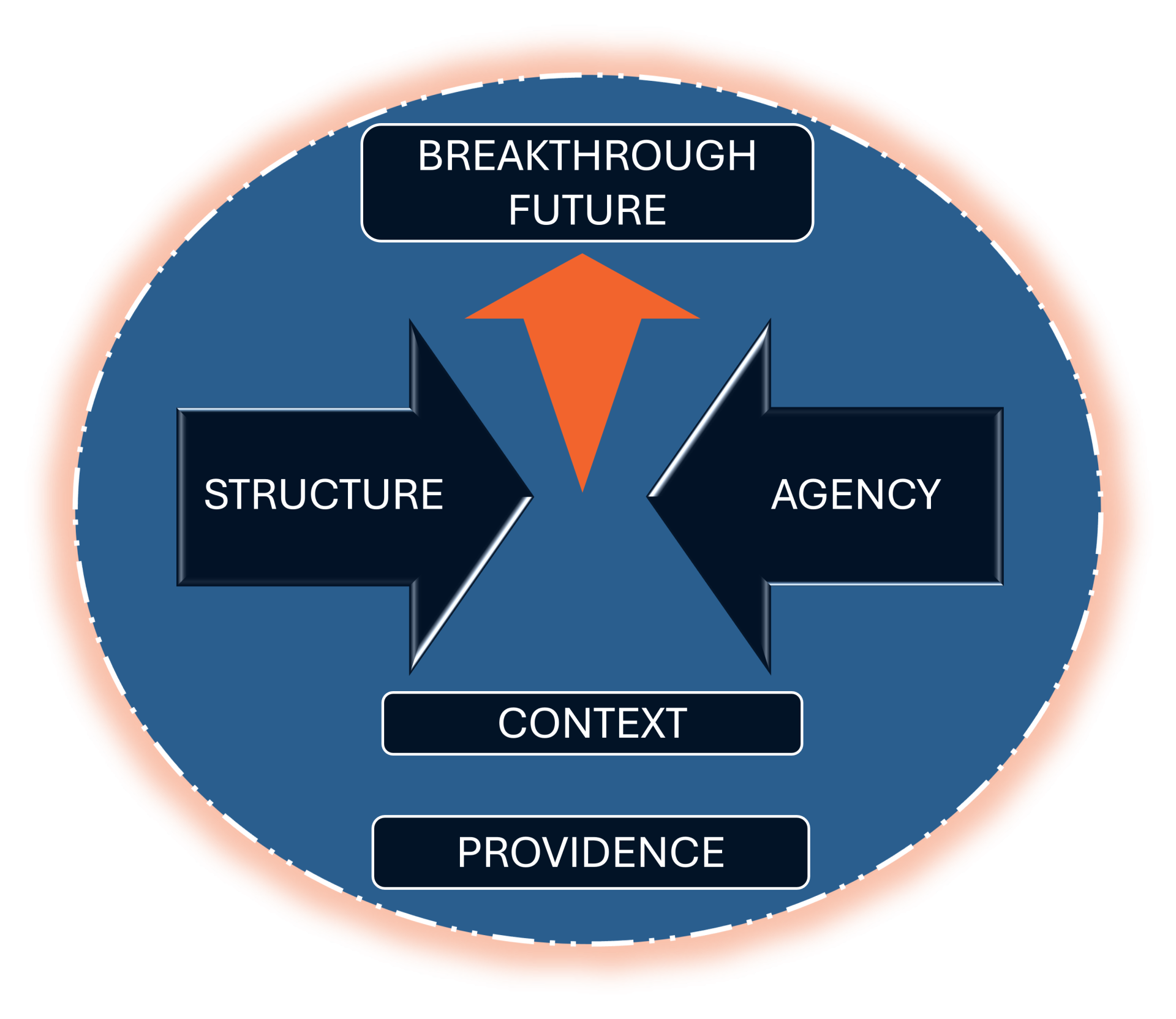
Social Structure is the formal and informal mechanisms that shape behavior – such as roles, norms, policies, meeting designs, reward systems. They don’t sit quietly in the background; they actively enable or constrain what feels possible for a team. The same idea, raised by two different people in the same meeting – only the one with the senior title gets asked to say more. The real question isn’t whether structures exist – they do – but what they’re serving: collective breakthrough, or the old patterns and past priorities already built into how things run.
Agency is the capacity of individuals and collectives to reflect together and act intentionally – not the sum of individual capability, but the emergent ability of a team to operate as a collective rather than merely report to each other. The moment a junior person honestly names the very problem every senior leader has been dancing around, and the meeting’s direction changes because of it.
Organizational Context is the situational factors and environmental conditions surrounding the work: market pressures, competitive dynamics, internal culture. Not passive background, but causally active in shaping what a team can achieve. A strategy that worked very well at the last company quickly fails here, despite similar talent – the market there was wide open; here it’s saturated, and no amount of execution skill changes that.
Breakthrough Future is a desirable yet seemingly impossible future reality a collective works from, not toward – transformational by orders of magnitude, so audacious it disrupts the status quo. It’s a goal so bold and compelling that saying it out loud in a planning meeting makes people uncomfortable, and it starts quietly pulling every decision in the room toward it.
Providence is openness to transcendent guidance and resources beyond human control: wisdom, timing, connections, support or influence that can’t be manufactured. The unplanned conversation, the introduction nobody engineered that turns into the resource that was needed, the door that closes and only in hindsight turns out to have redirected things toward something better, the funding that fell through and forced the team toward an approach that ended up mattering more. A question a collective rarely asks itself is whether it’s actually open to this kind of guidance, or has organized itself to notice only what it can control and take credit for.
Naming these five is the first step. What follows is how to begin catching them at work.
What training this looks like
None of these forces operate one at a time. In practice they are active together, in the same room, across the same stretch of time – sometimes reinforcing each other toward something nobody individually engineered, sometimes pulling against each other. Perceiving them well means watching for both kinds of interaction, not only the friction.
Triangulation. Individuals see only partial truth from their position and perceptions. Collectively, more of a single real whole becomes visible. That isn’t just a philosophical claim – it’s a method. If people in structurally different positions – different hierarchy level, different proximity to external markets and their actors, different function, different tenure – each independently notice the same friction or hesitation or pattern, that convergence is itself evidence the pattern is real and not personal. The same holds in the other direction: when several differently-positioned people independently sense something coming together – an opening, a readiness, a piece of momentum – that’s just as much evidence of a real force at work as friction is. A single person’s felt reaction, either way, could be projection. Several differently-positioned people converging on the same read is much harder to explain away as anyone’s individual noise. But convergence has to be tested aloud, not assumed – bringing those independent readings into the room and comparing them directly is what turns separate hunches into a shared, workable read. Emotional intelligence has its own collective version of this – following Vanessa Druskat and Steven Wolff’s research – team-level EQ treats a group’s shared trust, identity, and emotional climate as more than the sum of its members. That line of work continues in practical form, in Greaves and Watkins’ Team Emotional Intelligence 2.0. But even at that scale, the object stays the same: feelings, cohesion, relational quality. What’s added is more nervous systems, not a different kind of object. Triangulation, as BIQ uses it, adds people to test whether and how objective, causal forces are really at work – not to build shared emotional ground. This is perception as a collective – a comparative, sense-making act rather than an individual, introspective one. It is one place where BIQ’s causal-forces frame produces a practice with no real equivalent in even EQ’s group-level work.
Positional Awareness borrows a move empathy already makes – imagining another person’s perspective – but points it at something else. Empathy asks what someone else thinks or feels, in service of understanding and relating to them well. Positional Awareness uses their position as an instrument instead: not to understand them, but to see something neither person may be fully aware of – what the world looks like from a seat I don’t occupy, and what that reveals that my own seat hides from me. Sometimes what it reveals is an obstacle invisible from where you stand. Just as often it reveals a strength, an opening, or a resource that only shows up from that other vantage point. The object isn’t the other person’s inner state; it’s a reality outside both of you that their position happens to make visible. It’s a reality to discover, not a relationship to manage. That makes it a different move than Organizational Awareness, which reads the system from where you already stand, and different from empathy, which stops at a fuller, more accurate understanding of the other person. Positional Awareness stops somewhere else – at a fuller, more accurate reading of the objective but intangible world outside both of you, with their position as the instrument that made it more visible.
Temporal Patience. Certain forces – Providence especially, what BIQ names for the transcendent timing, influence, convergence, and resourcefulness that arrive from beyond anyone’s origination or control – can at times be felt while they’re happening, privately and tentatively, before they can be named with any confidence. At times they resolve into something closer to certainty afterward, when they can be recognized together with others, in hindsight. This is not general comfort with uncertainty. It is a discipline of holding a private sense and withholding firmer interpretation of a force like this until it can be tested against what others independently noticed too. Real-time noticing, EQ’s native mode, is built for immediate, individual clarity. Temporal Patience works against that instinct on purpose.
Reading Absence, Tracing Provenance (working backward from a result to its origins), Mapping Friction and Convergence. Reading Absence means noticing what’s missing – who’s structurally never in the room, what topic keeps leaving the agenda, or someone who’s gone quiet and may be sitting on something worth drawing out – rather than only what’s emotionally present in the moment. EQ’s empathy can catch a person going quiet in the moment; it has no equivalent for absence as a structural pattern across time. Tracing Provenance means working backward from a result, a success as much as a failure, to reconstruct the actual chain of structure, timing, and emergent supply that produced it, distinct from the story told about it afterward. Mapping Friction and Convergence has two halves. One half locates where proposals reliably die across repeated attempts – a signal that one of the causal forces may be working against something. The other half locates where energy reliably gathers and compounds across attempts, regardless of who’s driving it – evidence that several forces are working together. Tracing Provenance and Mapping Friction and Convergence have no real EQ counterpart, because neither is about anyone’s internal state or interpersonal read.
One more implication is worth naming. Not every person perceives all five forces with equal ease. Some register Social Structure quickly – the unwritten rules, the norms nobody states – while missing a real opportunity building in Organizational Context. Others sense Agency – its deliberations and when it’s exercised – but stay closed to Providential influence until long after the fact, if at all. This isn’t a claim that the forces themselves vary in actuality or strength from person to person; they don’t – that would undo the distinction this article is making. It’s a claim about differential perceptual attunement: which of the five forces a given person is naturally inclined to notice – some would call it a preferred style – and which take deliberate practice to develop at all. Because that attunement varies person to person, a collective’s fullest perception rarely comes from any one person. It comes from having differently-oriented people in the same room, comparing what each of them naturally perceives. That’s Triangulation again, now with mechanisms underneath it – not just different positions in a hierarchy, but different natural orientations toward what’s real. Together, they produce a fuller picture than any one orientation alone. Naming that variation is the starting point for a second, complementary construct: a BIQ Orientation Profile. It’s distinct from the causal claims made here – not how strong a force is, but how readily a given person works with it, relative to the other four. That instrument is in active development and will be introduced separately. What matters here is narrower: being attuned to and perceiving any of the five well, for anyone, takes training past the self, not just training the self.
What this doesn’t overturn
None of this makes emotional intelligence wrong. A calm, trained mind, and a mind practiced in reading others well, are probably preconditions for much of this – an untrained or purely self-absorbed mind is a poor instrument for perceiving anything, inward, relational, or otherwise. In several places, BIQ doesn’t discard EQ’s tools but repoints them: the same capacity for noticing a felt signal – tension and hesitation, but also a lift, an alignment, a sense of momentum building – that EQ trains someone to read relationally, BIQ uses as evidence that one or more of the causal forces are at work in a room or situation, not as the full explanation of it.
People construct different perceptions of the same event, and that’s plural – everyone’s vantage point is partial. What a self-centered view overreaches into is treating that plurality as the last word, as if there’s no single fact of the matter beneath it. Critical realism, following philosopher Roy Bhaskar, has a name for the alternative: reality is intransitive – it doesn’t wait for anyone’s theory of it, doesn’t rearrange itself around what any one observer believes, and isn’t simply whatever a group of observers agrees to treat as real. Margaret Archer, among others, extends Bhaskar’s insight into something more workable: forces that are real, causal, and intangible aren’t just defended philosophically – they’re at work, and they can be perceived and at least partially understood analytically, which is the whole premise this piece has been building toward. I then took that insight into organizational life. Doing that was research of my own, in a critical realist tradition others have brought into organizational study before me. It meant accessing organizations, identifying and analyzing examples, cataloguing mechanisms, explaining interactions, devising practices for perceiving them, and translating academic language into something a collective trying to get somewhere together could actually use. What emerged from that work is BIQ – the paradigm that points to and justifies the five forces making up its framework – and the means to recognize and work with each of them. Partial, positioned perceptions can be triangulated toward a fuller, never total, grasp of that single real objective whole. Not “I see truth, you see illusion.” Several partial vantage points, rigorously compared, converge on more of what’s real than any one vantage point alone – which is, not coincidentally, part of the case for doing this work collectively rather than individually.
Before the behavior. Before the numbers. Before the results. Before the impact – there is a set of causal forces at work, interacting, restricting and generating at once. Naming them correctly is what keeps a team working on the source of a problem and its solution, not just its symptoms. Efforts to recognize them more clearly take more than a well-trained mind observing itself, or reading others well. They take a mind trained to look past both – and, more often than not, more than one mind looking together, which is usually how the fullest and truest picture of what’s actually happening comes into view.
References
Anil Seth, Being You: A New Science of Consciousness (London: Faber & Faber, 2021).
Michael E Nagel, Are You Leading With Breakthrough Intelligence? (Collective Breakthroughs Whitepaper, 2024).
Michael E Nagel, Flourishing Together: What Actually Drives Breakthrough? (Generative Press, 2026).
Daniel Goleman, Emotional Intelligence: Why It Can Matter More Than IQ (New York: Bantam Books, 1995).
Vanessa Urch Druskat and Steven B. Wolff, “Building the Emotional Intelligence of Groups,” Harvard Business Review, March 2001.
Jean Greaves and Evan Watkins, Team Emotional Intelligence 2.0 (TalentSmartEQ, 2022).
Roy Bhaskar, A Realist Theory of Science (Leeds: Leeds Books, 1975).
Margaret S. Archer, Realist Social Theory: The Morphogenetic Approach (Cambridge: Cambridge University Press, 1995).